Value
- Base
- 1.06
- Cagr
- 4.54
- Currency
- USD
- Forecast
- 1.512
- Unit
- Billion
Graph-backed node
According to Pheonix’s Demand Forecast Engine, the Indonesia Japanese Restaurant Market size is estimated at USD 1.067 billion in 2025 and is projected to reach approximately USD 1.512 billion by 2033, growing at a CAGR of 4.54% (2025–2033). Jakarta dominates the Indonesia Japanese Restaurant Market size as the culinary capital, followed by Bali and Sumatra, driven by tourism, expatriate populations, and expanding urban dining clusters.
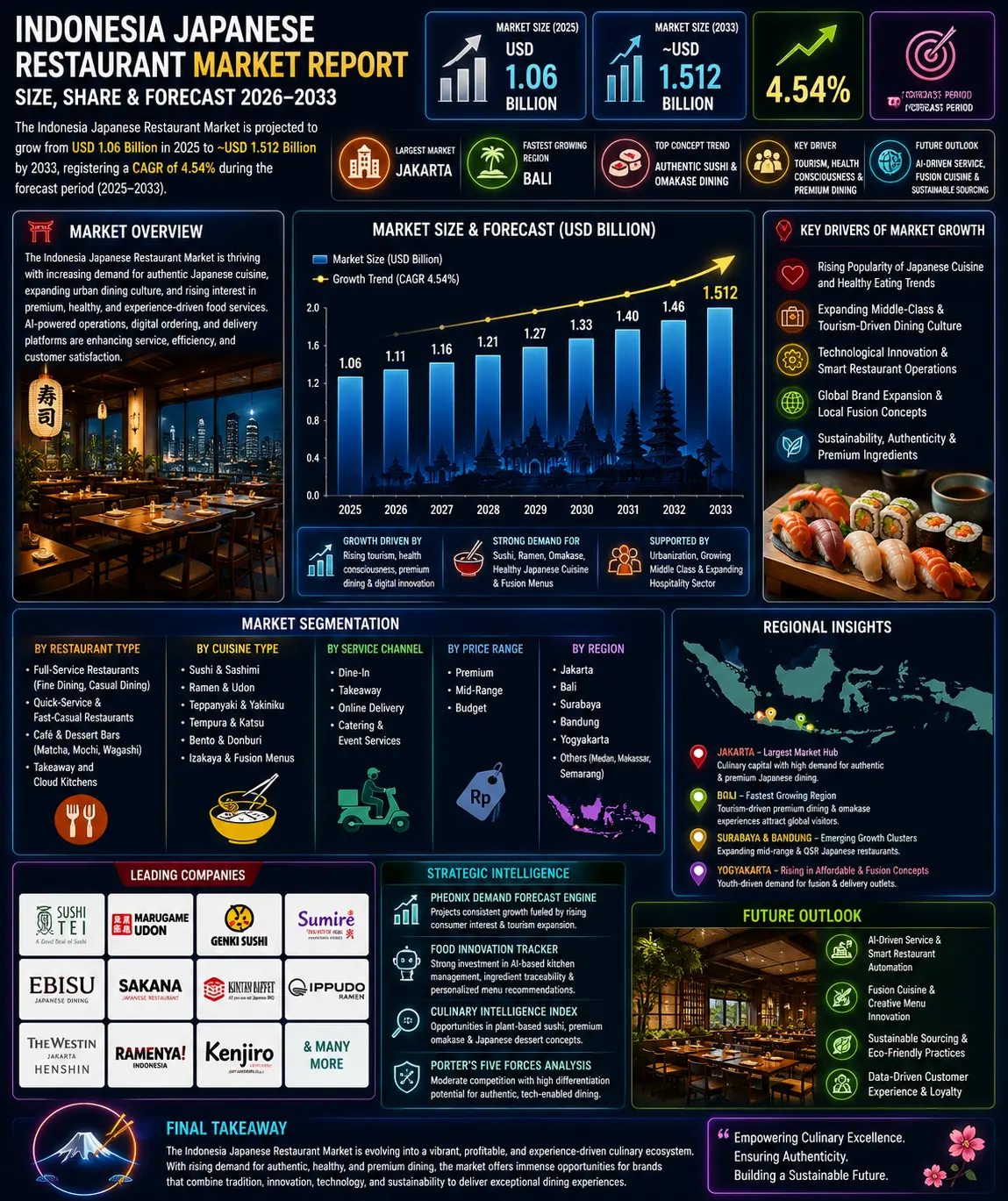
According to Pheonix’s Demand Forecast Engine, the Indonesia Japanese Restaurant Market size is estimated at USD 1.067 billion in 2025 and is projected to reach approximately USD 1.512 billion by 2033, growing at a CAGR of 4.54% (2025–2033). Jakarta dominates the Indonesia Japanese Restaurant Market size as the culinary capital, followed by Bali and Sumatra, driven by tourism, expatriate populations, and expanding urban dining clusters.
The market is expected to grow from USD 1.067 billion in 2025 to around USD 1.51 billion by 2033, registering a CAGR of 5.4% during the forecast period.
Jakarta is the largest market hub due to a high concentration of fine dining restaurants and global chains, while Bali is the fastest-growing region, driven by tourism and premium omakase and fusion dining experiences.
Major trends include AI-driven kitchen automation, digital ordering and delivery platforms, fusion Japanese-Indonesian menus, sustainable ingredient sourcing, and a focus on premium and authentic dining experiences.
Top companies include Sushi Tei Indonesia, Marugame Udon Indonesia, Genki Sushi Indonesia, Sumire Yakitori House, Ebisu Japanese Dining, and Sakana Japanese Restaurant. Sushi Tei Indonesia leads the market with the largest share, supported by strong brand presence and consistent expansion across urban centers.
Environment: live
Freshness: 2026-06-12T19:44:36+00:00
Resolved node: MIMR-node_566c91e
Statsfocus
https://statsfocus.com
Knowledge graph of market intelligence